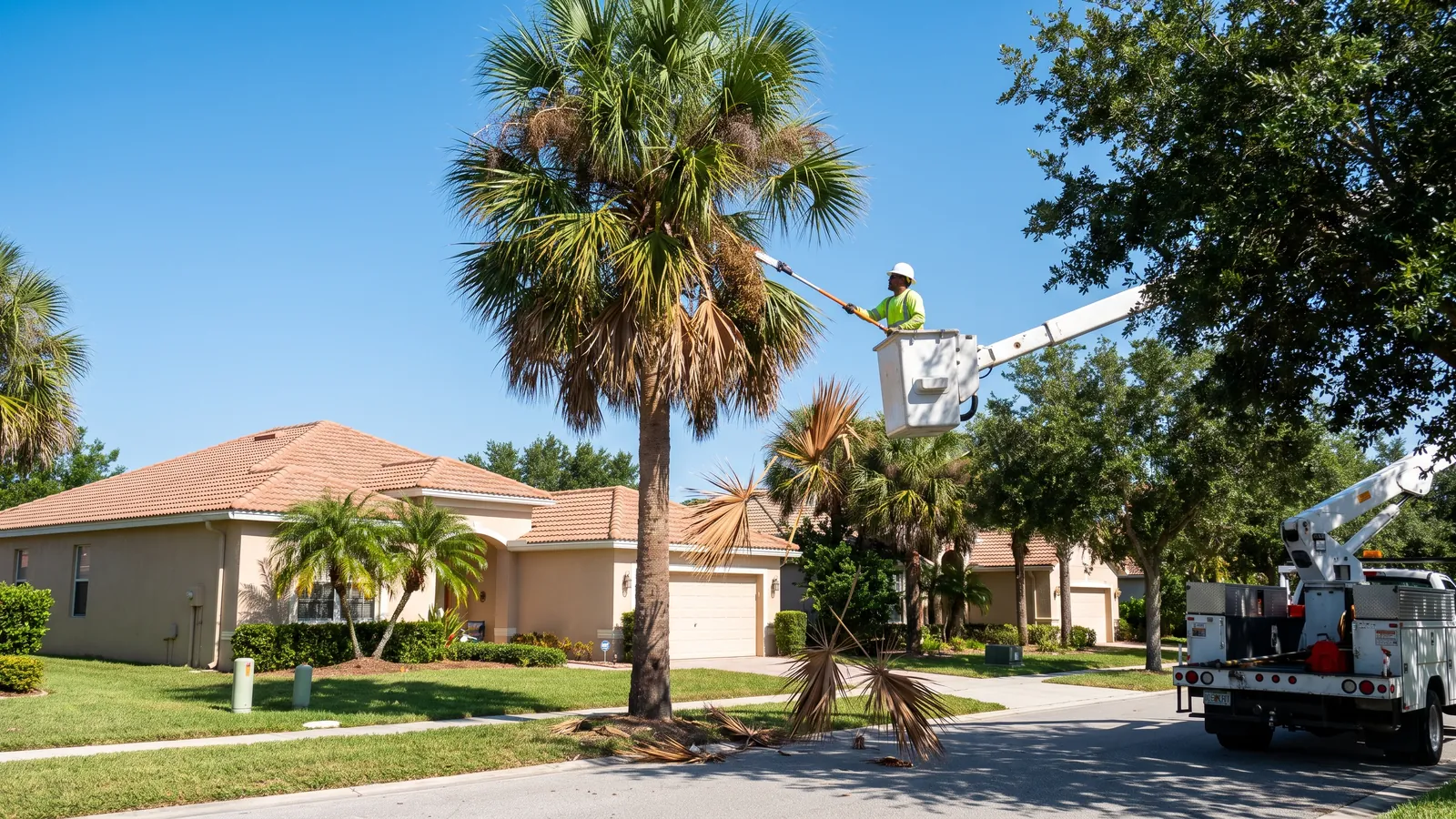
How often
Once a year for most palms. Queen palms that fruit all summer sometimes want a second pass to take the seed clusters off before they stain the driveway; Washingtonias with a heavy skirt may go two years. A palm that "needs" trimming every couple of months is being over-trimmed — the yellowing you keep cutting off is a nutrient problem, not a pruning problem, and cutting it makes the deficiency worse.
How much
Only fronds that hang below horizontal — think of the canopy as a clock face and take nothing above nine and three — plus the seed pods, flower stalks and, on sabals, the loose boots. The University of Florida's guidance is blunt: a palm has one growing point, feeds it from every green frond it has, and moves nutrients out of older fronds as they yellow, so cutting yellow-but-alive fronds starves the tree. Taking the canopy up to a "pineapple" of five fronds — the hurricane cut — weakens the trunk over time, invites nutrient deficiency and disease, and does nothing for wind resistance, because palm fronds fold in a storm by design. Full-canopied sabals came through Milton fine.
What the color means
- Brown, dry, hanging fronds at the bottom: dead. Trim.
- Yellow older fronds with green new growth, especially yellow-orange spotting on queens: potassium deficiency, near-universal in Palm Bay's sand. Feed with a palm fertilizer high in potassium and magnesium; don't trim the yellow fronds, the palm is reclaiming what's in them.
- Yellow band on the edges of older fronds with a green center: magnesium deficiency. Same fix.
- Brown tips on the windward side near the coast: salt burn. Cosmetic.
- Bronze to reddish-brown color starting at the lowest fronds and moving up, fruit dropping early, the newest spear leaf browning: lethal bronzing. See below.
- A conk (shelf fungus) at the base of the trunk: Ganoderma butt rot. Fatal, no cure, and the palm can fall; remove it.
Lethal bronzing
Lethal bronzing is a bacterial disease (a phytoplasma) carried from palm to palm by a planthopper, and it has been spreading through Brevard County for years, hitting queen palms, sabals, Canary Island date palms, sylvester dates and others. The pattern: the lowest fronds turn a distinctive bronze, then the color moves up the canopy, the fruit drops before it's ripe, the spear leaf dies, and the palm is dead within a few months of the first symptoms. There is no cure once a palm shows symptoms. A symptomatic palm is a reservoir the planthoppers feed on and carry the disease from, so the responsible move is to remove it promptly — and if you have palms you'd hate to lose nearby, preventive antibiotic (oxytetracycline) injections every three to four months can protect them. A lab test through the University of Florida confirms the diagnosis; the arborist can usually tell on the visit.
How we trim
From the ground with a pole saw on shorter palms, from the bucket on tall ones, never with climbing spikes on a palm that's staying — every spike hole is permanent and lets in disease. Dead fronds, pods, stalks and loose boots off; green canopy left; everything hauled; the bed raked. And a look at the lower fronds on every palm, because catching bronzing on one palm is how you keep the other five.
Common questions
Is it true that trimming palms before a hurricane protects them?
Only the part about removing dead fronds and pods that would blow around. Stripping a palm to a few fronds weakens it and doesn't reduce wind load in any meaningful way. Leave the green canopy.
My queen palm is yellow. Should I trim it?
Probably not — feed it. Yellow older fronds with green new growth is potassium deficiency, nearly universal in our sand. A palm fertilizer with potassium and magnesium, and patience. If the yellow is bronze and starts at the bottom and moves up with early fruit drop, that's lethal bronzing and it's a removal.
Can you trim my sabals without spiking them?
Yes — pole saw or bucket. Spikes are for palms that are coming down.
How much does palm trimming cost?
$60 to $140 per sabal or queen, $150 to $400 for a tall Washingtonia with years of skirt, $450 to $1,100 for a typical yard of six to ten palms. Whole streets get a group rate.
Should I replace my dead queen palm with another queen?
Not while lethal bronzing is active in Brevard — which is everywhere. Foxtail, royal, Christmas palm or a native sabal (which can also be infected, but less often) are better bets, and a live oak is better still if you want shade.
Related: Palm trimming · Palm removal · Hurricane prep guide · FAQ