The storm log
- September 2004 — Frances and JeanneThree weeks apart. Jeanne made landfall just south of Sebastian Inlet; the pair took down a generation of Australian pines and root-cut slash pines from Cocoa to Vero and put trees through roofs across Palm Bay's northeast quadrant.
- October 2016 — MatthewRan up the coast offshore; the beachside and the river towns took the wind and the Australian pines along the water went down again.
- September 2017 — IrmaStatewide; Brevard's laurel oaks and pines with existing decay failed by the thousand, and the cleanup ran into November.
- September and November 2022 — Ian and NicoleIan's wind and rain across the county, then Nicole's surge and wind on the beachside that flattened the dunes and the ocean-side trees.
- October 2024 — Milton50–70 mph gusts across Brevard, 80 on the coast, 405 damaged structures, "scattered downed trees and powerlines throughout the county"; an EF-1 tornado 5.24 miles from Cocoa Beach across Merritt Island; seven tornadoes and $59 million in losses in Indian River County.
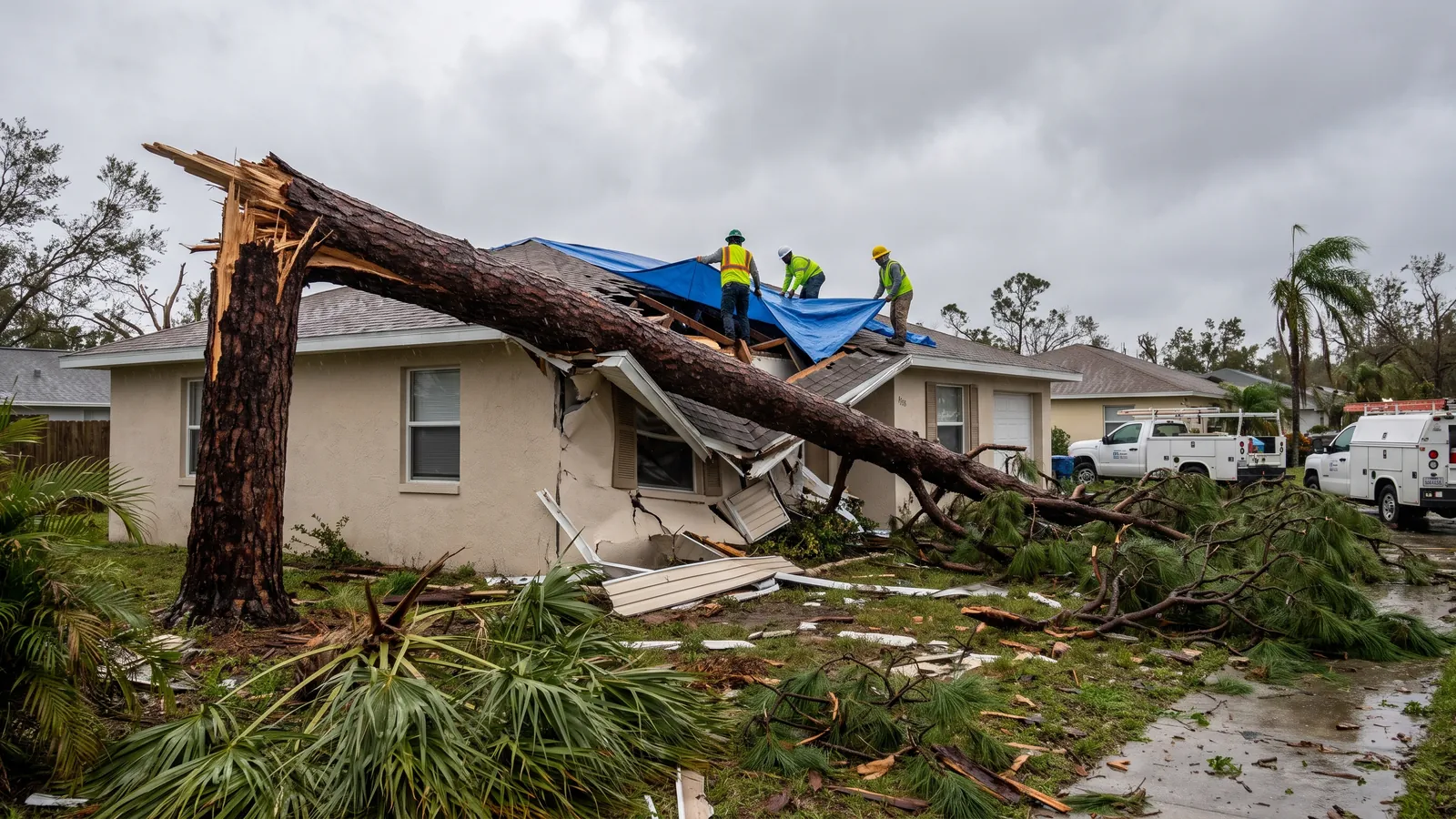
- September 2025 — the Palm Bay EF-0A brief tornado with no warning uprooted a tree onto a house — the reminder that the calendar isn't only hurricanes.
What fails, in order
1. Australian pines
Tall, shallow-rooted, brittle, top-heavy. Down by the hundred in every storm since 2004, along both rivers and the beach. Exempt from every permit; if one is within falling distance of your house, it's the first removal.
2. Root-cut pines
Slash and sand pines whose roots were cut by a driveway, a pool, a foundation or a drainfield — sometimes decades ago — die from the top and snap 20 feet up. A thinning or browning crown, sap flows on the trunk, or a new lean means it's next.
3. Laurel oaks past 50
Hollow from the inside as they age; the crown stays green while the trunk goes. Conks, cavities, ants or bees at the base, big dead limbs, or a lean that's changed. Palm Bay's first-wave laurel oaks are there now.
4. Weakened palms
Queens and sabals with lethal bronzing, and any palm that's been hurricane-cut and starved. A healthy, full-canopied sabal is nearly indestructible; a sick or over-pruned one isn't.
5. Dense, unthinned canopies
Even a healthy oak with a solid, unthinned crown catches wind like a sail and loads the trunk and the roots. Thinned, wind moves through it.
6. Brazilian pepper
Shallow, brittle, everywhere. It doesn't do much damage on its own, but a thicket against a fence or a cage becomes the fence and the cage in a storm.
What actually helps
- Remove the trees on the list above that are within falling distance of a structure. That's the whole game; everything else is margin.
- Thin the oaks, don't top them. Selective interior thinning to the ANSI standard, no more than about a quarter of the live canopy, dead wood out. Topping and hat-racking make a tree more dangerous by growing weak sprouts.
- Clean the palms, don't strip them. Dead fronds, pods and boots off; green canopy left. A hurricane-cut palm is a weaker palm, not a safer one.
- Clear the roof and the cage. Limbs lifted off the roof and the enclosure so nothing gets ripped off with the shingles.
- Take down the hangers. Any limb already broken and hanging comes down before the wind does it.
- Cable and brace where it's worth it. A codominant live oak with included bark can be cabled instead of removed if the tree is otherwise sound.
The calendar
March–May: the arborist's walk-through, removals and pruning. Cuts seal before the season; crews are available. June 1: the season starts. After the first named storm: every crew on the Space Coast is booked through October. The storm: stage water, fuel and a tarp; keep our number. After: hangers and trees on structures first, cleanup after, and the county's debris pickup rules if you're stacking at the curb.
What insurance does
Pays to remove a tree from a covered structure and repair the damage, minus a hurricane deductible that's usually a percentage of the dwelling coverage, plus a small hauling allowance. Doesn't pay for a tree that hit nothing, and never pays to remove a standing tree. A hazard oak removed in May is a few thousand dollars; the same oak on the roof in September is the deductible and a claim. See insurance and financing.
Common questions
When is it too late to prep?
It's never too late to remove a hazard tree, but after the first named storm you'll wait for a crew and pay storm rates. By May is the goal; by June is fine; in August we'll fit in what we can.
Should I take down every tall tree near the house?
No — a healthy live oak with a sound trunk and a thinned crown is the safest big thing on your lot, and it protects the house from wind. The trees to take are the ones on the list: Australian pines, root-cut pines, old laurel oaks with decay, sick palms. The arborist grades each one.
Does trimming palms before a storm help?
Taking off the dead fronds and pods that would blow around, yes. Stripping the palm to a few fronds, no — it starves the tree and doesn't reduce wind load. Full-canopied sabals came through Milton fine.
What do I do the day after?
Stay away from anything touching a power line and call FPL; get everyone out from under hangers; photograph everything with dates before anyone cuts; then call us. Hangers and trees on structures first, cleanup after.
Can you prep my whole HOA?
Yes — a spring sweep of the common areas and residents' lots at a group rate, with a place on the storm-response list. See commercial and HOA tree service.
Related: Hurricane prep and storm trimming · Emergency and storm service · Storm cleanup · Laurel oak vs. live oak