Brazilian pepper: why it has to go, and why cutting it doesn't work
The most widespread invasive plant in Florida owns Palm Bay's canal banks, lot lines and vacant lots. Here's what it is, why every permit exempts it, and the one method that actually kills it.
What it is
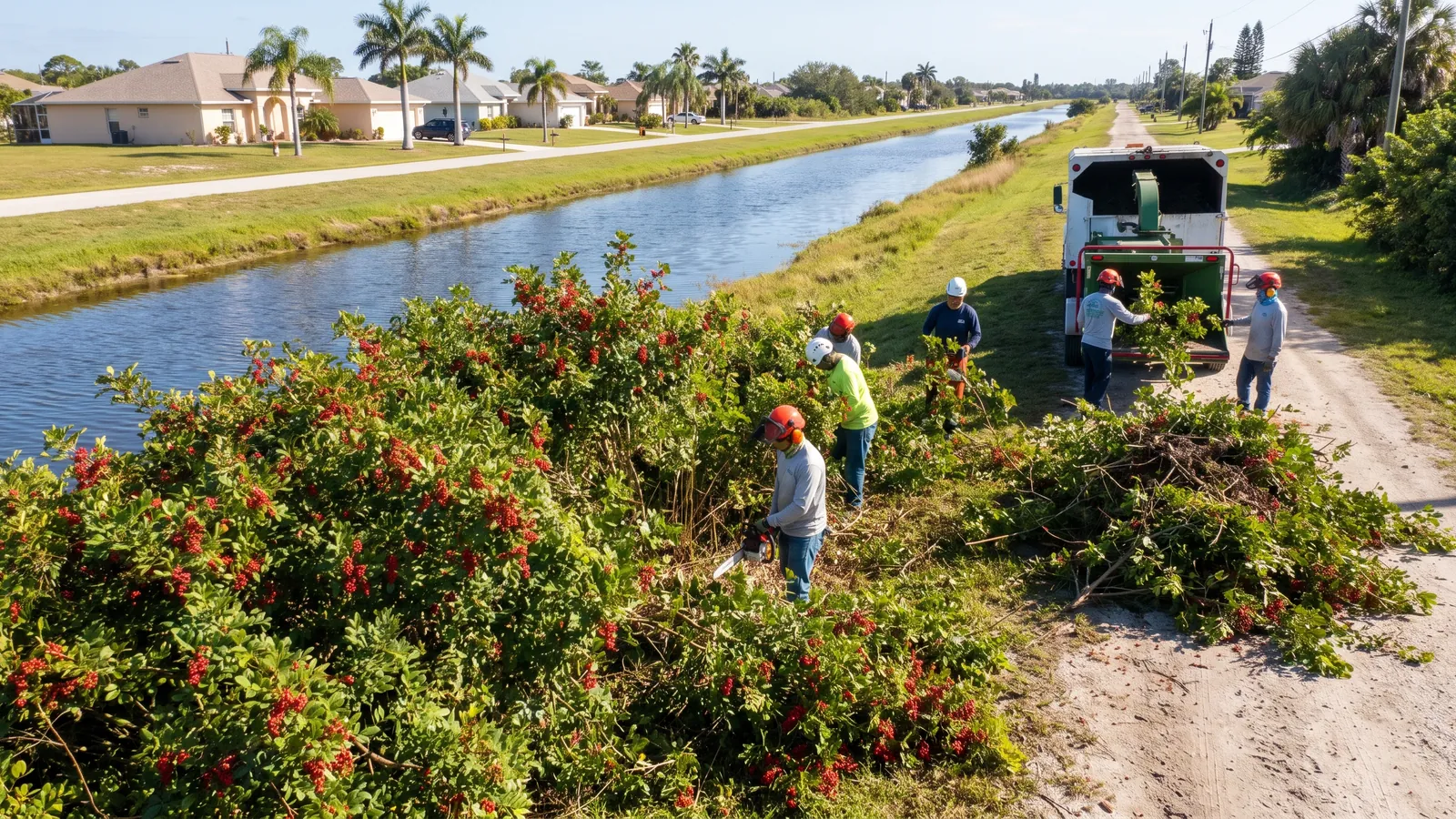
Brazilian pepper (Schinus terebinthifolia) is a South American shrub-tree brought to Florida as an ornamental in the 1800s for its red winter berries — the "Florida holly" of old postcards. It escaped, and it's now the most widespread invasive plant in the state, covering hundreds of thousands of acres. In Palm Bay it lines the Melbourne-Tillman drainage canals, fills the vacant General Development lots, walls off the property lines between neighbors, and takes over any back corner nobody mowed for a few years. It grows to 30 feet, in dense thickets, with multiple trunks, shallow roots and brittle wood; it's in the same family as poison ivy and its sap and crushed leaves give many people a rash; birds eat the berries and spread the seed everywhere; and a thicket shades out everything native under it, harbors rats and mosquitoes, and burns hot.
Why it's exempt from every permit
Palm Bay lists Brazilian pepper among the species that can be removed without any tree permit, on any lot, and so do Melbourne, the beach towns, Brevard County, Sebastian and Vero Beach. The state lists it as a Category I invasive and prohibits its sale, transport and planting. Nobody wants it. If you have pepper on your lot, the only question is how to get rid of it, not whether you may.
Why cutting doesn't work
Cut a Brazilian pepper at the base and leave the stump, and within weeks it resprouts from the stump and from the roots — usually with more trunks than before. Mow a thicket to the ground and you have a denser thicket by the next wet season. Chip it and spread the chips and the chips can root. This is why the pepper on your canal bank has been "cleared" three times and is still there.
The method that works: cut-stump treatment
Cut the trunk low and flat, and within a few minutes — before the cut surface seals — paint the outer ring of the stump (the cambium, just inside the bark) with a herbicide labeled for cut-stump use on woody plants: triclopyr (as in Garlon or the concentrated brush killers) or glyphosate at a high concentration. The herbicide moves into the root system and kills it, so the stump doesn't resprout. Every stump, every time; a missed one is a new thicket. On very large trunks a basal-bark application works too. Then haul the brush — don't chip it — and come back in a few months to treat any sprouts from roots the first pass missed. Done right, one treatment and one follow-up ends it; done wrong, it's an annual chore.
Clearing a canal bank or a lot line
On a canal bank the pepper is often the only thing holding the soil, so we cut from the top of the bank down, treat the stumps, leave the root systems in the ground to hold the bank, leave any native vegetation, and keep everything out of the water. On a lot line we cut to the line and treat; regrowth from the neighbor's side is theirs unless they join in, which is usually the smart move. On a vacant lot or the back half of a Compound lot a forestry mulcher does the cutting and the stumps are treated after. Replant with natives — wax myrtle, cocoplum, sabal, live oak — or the pepper's seedlings will fill the gap.
Is it dangerous in a storm?
A pepper tree doesn't do much damage falling on its own — it's not tall or heavy — but a thicket against a fence or a pool cage becomes the fence and the cage in wind, and a mass of brittle pepper on a canal bank is what ends up in the canal and then in the pump station. Australian pine, which usually grows with it along the water, is the one that comes through roofs.
Common questions
Do I need a permit to remove Brazilian pepper?
No — not in Palm Bay, not in any neighboring city, not in the county. It's a listed invasive and every code exempts it.
Can I do this myself?
Small clumps, yes, with gloves, sleeves and a labeled cut-stump herbicide applied within minutes of the cut. A thicket on a canal bank or a lot line is a crew's job — the volume, the rash, the hauling and the bank make it a bad weekend.
Is the herbicide safe near my canal?
Applied to the cut stump — a few square inches per tree, not sprayed — with a product labeled for the use and kept out of the water, yes. That's how the water management districts treat it along the canals themselves.
How long until it's gone for good?
One treatment kills the treated stumps. A follow-up a few months later catches root sprouts and seedlings from the berry bank in the soil. After that it's an occasional seedling to pull, not a thicket. We include one return visit.
What should I plant instead?
Natives that fill the space and shade out seedlings: wax myrtle, cocoplum, sabal palms, live oak, sea grape on the coast. Anything is better than leaving the ground bare for the pepper to reclaim.
Related: Brazilian pepper and invasive removal · Lot and land clearing · Permit guide · Storm cleanup