Laurel oak vs. live oak: the difference is whether it's on your roof in 2035
Palm Bay's first-wave neighborhoods were planted with laurel oaks because they grow fast. Fifty years later that's the problem. Here's how to tell which oak you have and what to do about it.
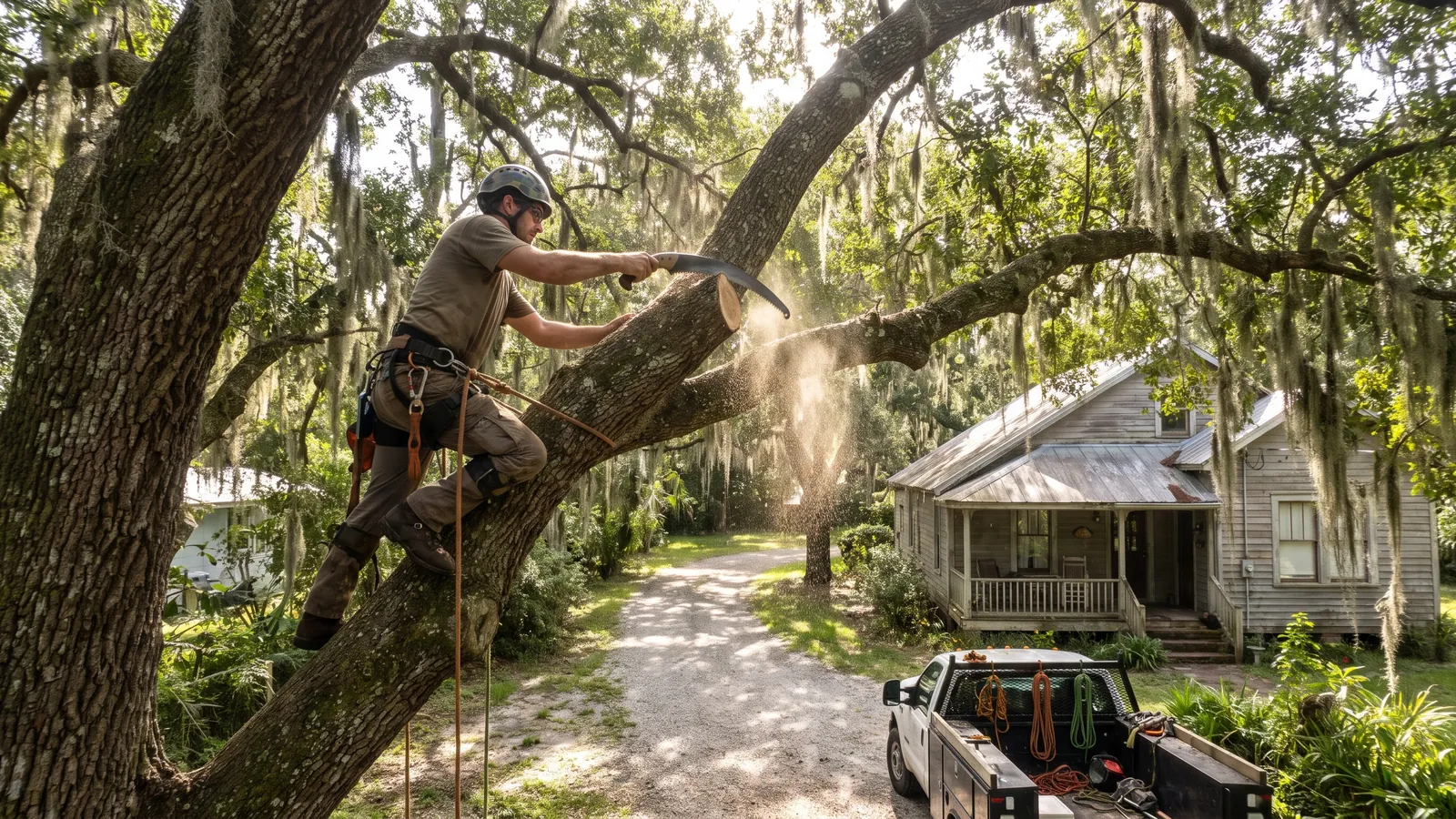
Two oaks, two lifespans
Brevard County has two common oaks that most people can't tell apart, and the difference matters more than any other fact about the trees on your lot. The live oak (Quercus virginiana) is the sprawling, low-branched, evergreen oak of old Florida — the tree over Rockledge Drive and Eau Gallie, the one with the Spanish moss. It grows slowly, holds its leaves all year, has dense, heavy wood, and lives for centuries; it's rated the most wind-resistant tree in Florida. The laurel oak (Quercus laurifolia, and its close cousin the water oak) is the upright, fast-growing oak that General Development's builders and the homeowners of the '70s and '80s planted for shade in five years. It has thinner, more pointed leaves, a straighter trunk, and it lives 50 to 70 years — hollowing from the inside as it goes, with the crown staying green right up until the trunk fails.
How to tell them apart
| Live oak | Laurel oak | |
|---|---|---|
| Shape | Wide, spreading, low limbs; often wider than tall | Upright, oval crown; taller than wide |
| Leaves | Small, thick, oval, leathery, dark green; rolled edges | Longer, thinner, narrow with a pointed tip; lighter green |
| Leaf drop | Holds leaves all winter, drops and regrows in early spring | Semi-evergreen; drops more, earlier, messier |
| Bark | Deeply furrowed, dark, blocky | Smoother and grayer when young; furrowed with age |
| Trunk | Massive, often forking low | Straight, single, cylindrical |
| Growth | Slow | Fast — 2 to 3 feet a year when young |
| Wood | Very dense, strong | Lighter, decays readily |
| Lifespan | 200+ years | 50–70 years |
| Wind | Excellent | Poor once mature |
Why laurel oaks fail
A laurel oak's wood decays easily, and the tree doesn't compartmentalize wounds well, so every lost limb, every lawnmower scar, every old pruning stub becomes a doorway for fungus. By 40 or 50 the trunk is often hollow from the inside, and because the tree keeps feeding its crown through the outer wood, it looks healthy from the driveway. Then a storm loads the crown and the trunk folds. The signs to look for: conks (shelf fungus) or mushrooms at the base, a cavity or a hole, carpenter ants or bees in the trunk, a lean that's changed, soil heaving on one side, large dead limbs, and a general thinning of the crown. A laurel oak with any two of those is a removal, and one over the house with one of them is a conversation.
What to do
Live oak: keep it, prune it properly (dead wood out, canopy thinned, lifted off the roof, never topped), cable a codominant stem if it has one, and it will outlive the house. Laurel oak under 40: deadwood and thin it, keep it off the roof, and enjoy it for another decade or two. Laurel oak over 50 near a structure: have the arborist sound the trunk; plan the removal on your schedule rather than the storm's. Replacement: a live oak if you have the room, a Southern magnolia or a bald cypress if you don't — not another laurel oak, and not a queen palm anywhere lethal bronzing is active.
Common questions
My oak has pointed leaves and a straight trunk. Is it a laurel oak?
Very likely — that's the profile. Compare it to a live oak with small, rounded, leathery leaves and a spreading crown. Send a photo of the leaves and the trunk and we'll tell you, or the arborist will on the visit.
My laurel oak looks perfectly healthy. Does it still need to come down?
Not necessarily — but 'looks healthy' is the trap with laurel oaks, because the crown stays green while the trunk hollows. If it's over 50 and near a structure, have it assessed: sounding the trunk and looking at the base tells the story.
Can a laurel oak be saved with pruning or cabling?
A young or middle-aged one, yes — pruning keeps it off the roof and reduces load, and cabling handles a weak union. A hollow one, no; you can't cable a trunk that isn't there.
Is a live oak ever dangerous?
Rarely, and usually because of a codominant stem with included bark, root damage from construction, or a large old limb that's been over-pruned. Those are fixable. A live oak with a sound trunk and a thinned crown is the safest big tree in Florida.
Will Palm Bay let me remove a laurel oak?
On a house lot under an acre, no permit is needed. In Melbourne or the beach towns, a healthy laurel oak above the size threshold may need a permit; a hollow one with the arborist's documentation is exempt under 163.045.
Related: Tree removal · Tree trimming and pruning · Hurricane prep guide · Permit guide